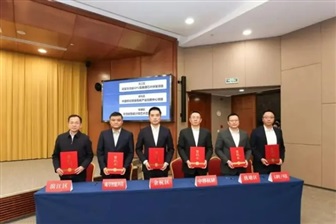
On February 28, Hangzhou convened an AI development summit at the Hangzhou Civic Center aimed at positioning the city as China’s leading artificial intelligence (AI) hub. According to East Money and Xinhua, 12 AI projects were signed, with a total investment of CNY25.5 billion (US$3.71 billion).
The only project dedicated to AI inference GPUs was Sunrise’s “High-Performance GPU and Inference Chip R&D Project.” The Zhejiang-based company signed the project in Hangzhou as part of the city’s computing infrastructure initiative.
Sunrise Co-CEO Wang Zhan said computing power, not model capability alone, will determine future industrial development, adding that Hangzhou’s AI strategy offers a supportive environment for the company’s expansion.
In a statement, Sunrise said the agreement marks a new stage of its Hangzhou expansion and will support the city’s AI computing infrastructure and broader innovation framework.
Sunrise was previously the large-chip unit of SenseTime and was spun off at the end of 2024. It develops high-performance GPUs and multimodal inference chips for commercial deployment. The company cites multiple generations of validated products, though statements such as “ten-thousand-card-scale delivery” originate from corporate and local disclosures rather than independent third-party verification.
China’s AI chip deployment expands across multiple vendors
Sunrise’s project reflects local governments’ strategic support for domestic AI computing providers, but it is not the only force in China’s AI chip deployment. Reports from international and domestic media indicate that China’s AI computing supply and substitution strategy has evolved into a multi-player structure.
Huawei Ascend Series: A unified platform for training and inference
Huawei’s Ascend series, including the 910C, has been cited by major media as one of China’s primary domestic platforms for large-model training and inference. Reports indicate the company is preparing for large-scale shipments to meet demand for alternatives to Nvidia, although manufacturing capacity and policy constraints continue to limit supply.
US officials have indicated that domestic production may remain limited, with one estimate suggesting 2025 shipments could be capped at about 200,000 units, highlighting ongoing supply chain and technology constraints.
Multiple domestic AI accelerator providers
Beyond Huawei, another major source of AI chip supply in China comes from AI accelerators and inference-focused processors.
Cambricon is frequently cited as a representative domestic AI accelerator vendor. Its MLU series has appeared on government and enterprise procurement lists. The Financial Times reported that Huawei and Cambricon chips were included in official domestic procurement programs to support indigenous technology development.
Reuters reported that the China Unicom data center in Xining, Qinghai, deployed multiple domestic AI chips, including products from Alibaba’s T-Head, MetaX, and Biren. The project illustrates real-world deployment of Chinese AI processors in large-scale infrastructure.
The Reuters report also stated that Moore Threads and Enflame Technology are expected to supply chips for later phases of the data center and related cloud projects.
Chinese media have reported that Enflame is advancing a STAR Market IPO, indicating continued capital market activity alongside product development.
Credit: AFP
Domestic CPU replacement efforts expand
At the CPU level, vendors such as Loongson and Phytium are positioned as domestic alternatives in government, state-owned enterprise, and industrial server environments, though they do not directly replace AI training accelerators.
China is progressively limiting the use of Intel and AMD chips in government-funded systems to promote domestically developed alternatives, providing policy support for vendors including Loongson and Phytium.
China’s AI chip ecosystem enters a multi-vendor phase
Sunrise’s GPU and inference chip project in Hangzhou represents one example of collaboration between local governments and emerging chipmakers. However, broader deployment trends reported by major global media and first-hand project cases show:
● Huawei Ascend is one of the few domestic computing platforms with concrete shipments and deployments in large-model training.
● Alibaba T-Head, MetaX, Biren, and Cambricon chips have been deployed or planned in major data center projects such as China Unicom’s facilities.
● Moore Threads and Enflame are emerging as additional supply sources.
● Chinese CPUs, including Loongson and Phytium, are advancing substitution in server and government applications under policy support.
China’s AI chip ecosystem is shifting from reliance on a single supplier to a multi-vendor structure. However, gaps remain in computing scale, manufacturing capacity, and global ecosystem integration compared with Nvidia and established international supply chains.
Article edited by Joseph Tsai