The pop-up power plants may be popular with technology companies, but plans for installing them have stirred opposition in some communities.
Last spring, officials in Virginia’s Pittsylvania County voted down a proposed data center “megacampus” that would have been powered by a 3,500-megawatt gas-fired power plant. Local opposition to the project grew after researchers from Harvard University used computer modeling to predict that the power plant could result in more than $31 million in annual health care related costs.
Michael Cork, a health scientist at the Harvard T.H. Chan School of Public Health, conducted a similar analysis of the Vantage data center in Sterling as part of his consulting group, EmPower Analytics Group. The analysis, released last week, found that soot emissions from the facility could cause tens of millions of dollars in annual health impacts, not just in Sterling and Loudoun County but as far away as the District of Columbia and parts of Maryland.
“Because it’s located in a densely populated area of the country, even modest increases in pollution can translate into substantial public health costs and implications,” he said.
Both studies used an Environmental Protection Agency mapping tool to estimate the power plants’ health impacts. Cork’s analysis, funded by the local environmental group Piedmont Environmental Council, underscores that data centers’ costs are not just financial.
“It’s not just a question of reliability or affordability, it’s also a public health question, and quantifying the health burden is crucial so that policy makers and regulators can make their own decision about how to support digital infrastructure while also protecting air quality and saving lives,” Cork said.
While Vantage’s Freeman disputed the findings, he did not respond when asked for information about the facility’s actual emissions and how they might differ from what its permit allows.
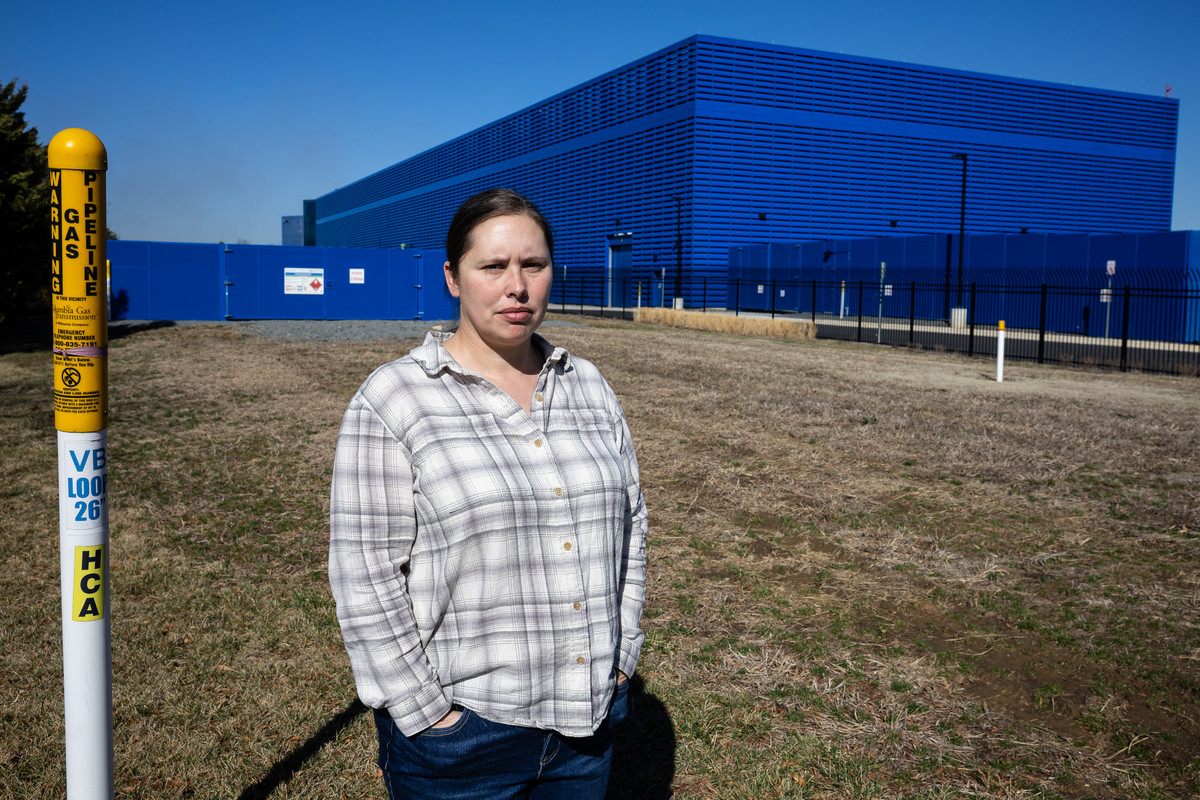
Jessica Medeiros, who lives an estimated 600 feet from the data center, said it has not just disrupted her sleep but caused her to feel congested when in her home and her neighborhood. The symptoms disappear when she leaves the neighborhood, she said, but come back when she returns home.
“People talk about the cloud like it’s something floating in the sky, but for those of us living right next to these facilities, the cloud comes with a noise and feeling like I have allergies year-round, whenever I’m in my house,” she said.
‘No zoning rules to cover this’
Regardless of what Trump and the industry pledged last week, decisions about whether to allow data centers to generate power on-site come down to local officials tasked with approving zoning ordinances and variances.
The Vantage facility is just one of 200 data centers in Loudoun County, whose massive concentration of the computing hubs hosts much of the world’s internet traffic and has given it the nickname “Data Center Alley.” Following complaints about Vantage’s on-site turbines, local officials are working on updating the county’s comprehensive plan to address concerns including those involving on-site gas turbines and noise.
“There are no zoning rules to cover this,” county Board of Supervisors Vice Chair Michael Turner said in an interview.
Turner said county officials didn’t understand in 2022 and 2023 exactly what it meant to have gas turbines at a data center, nor did they have zoning rules to address it.
When Vantage submitted its building plans to the county, the plan was to use gas turbines only temporarily, not as a primary power source. Because data centers typically include backup diesel generators and other temporary power sources, it seemingly complied with the zoning ordinance, and the county allowed the project.
At the time, county rules allowed data centers to be built “by right” without any public hearing that might have invited more scrutiny.