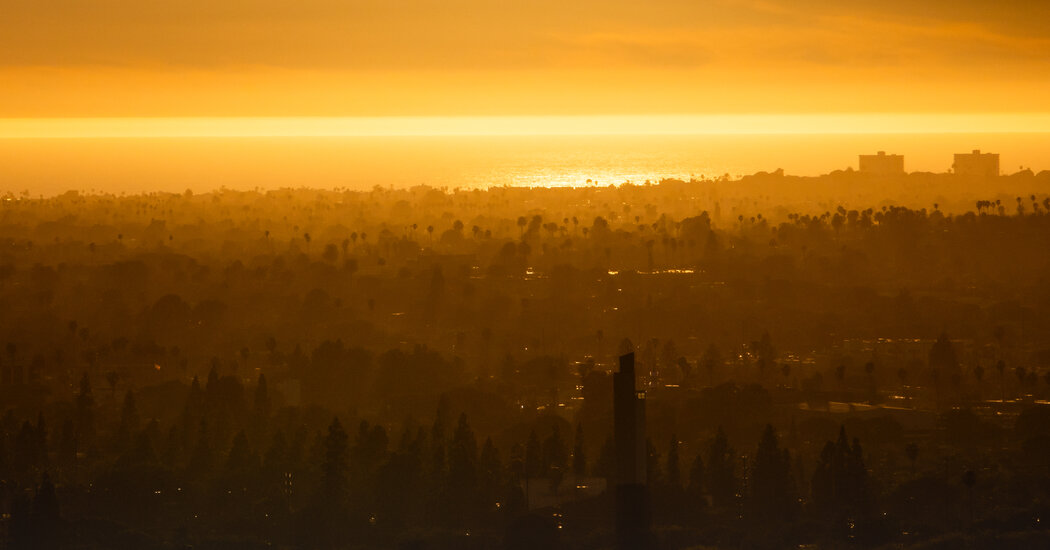
It’s the middle of March, and a full-scale summer-style heat wave is expected to bring scorching weather to California and the Southwest over the next week.
In desert areas of Southern California and Arizona, temperatures could soar above 105 degrees, while warm, balmy beach weather in the 80s and 90s is expected along the California coast from San Diego and Los Angeles to San Francisco.
“It’s going to feel like summer for sure,” said Chandler Price, a meteorologist for the National Weather Service’s office in San Diego. “Early summer in San Diego is usually pretty nice, as we have a nice gentle breeze and some marine layer clouds, but this March heat wave is going to feel like July or even August for quite a few areas.”
Forecasters warned the heat could be dangerous, especially because people aren’t used to such high temperatures at this time of year. Heat advisories and even extreme heat watches have been issued in many areas.
The Southwest will be at the center of this exceptional heat.
This heat will be centered over California and the Southwest, stretching from San Francisco to Los Angeles on the coast and Phoenix and Denver inland.
But it won’t be limited to those areas. While the most stifling weather will remain focused over the Southwest, the warmth will permeate a much broader area of the West. By next Thursday, temperatures will be above average in nearly every state west of the Mississippi River.
Forecasters are calling this heat wave unprecedented for March. Dozens of daily records for high temperatures are expected to fall, and many places are likely to set high temperature records for the month, the Weather Prediction Center said.
The highest temperatures are expected next week.
The warm-up has already begun. Temperatures across California and the Southwest are expected to be about 10 to 20 degrees above normal over the weekend. They will then start spiking rapidly on Monday and will grow progressively hotter through the week, getting up to 15 to 30 degrees above normal, in most of the affected areas.
Temperatures will be in the 80s and even the 90s across the San Francisco Bay Area next week. It’s unusual for San Francisco to hit 80 degrees at any time of the year, and next week the city is likely to reach that temperature or higher every day from Monday to Friday — “and likely more, because our official forecast does not go out beyond Friday,” said Joe Merchant, a meteorologist with the Weather Service office in Monterey, Calif.
In the coastal areas around Los Angeles, widespread 90s are expected next week. The heat wave could rival a similar one that occurred in March 1988.
“Even when the sun goes down, it will still be pretty unpleasant and warm in the evening hours,” said Ryan Kittell, a meteorologist with the Weather Service office in Oxnard, Calif.
The hottest places could get up to 110 degrees.
The hottest weather is expected in the deserts of Southern California and Arizona, where extreme heat watches will go into effect in the middle of the week, and some places could set records for their earliest 100-degree days of the year.
Palm Springs could reach 110 degrees by Thursday, shattering its March record of 104.
Phoenix is on track to record its earliest-ever 100-degree day, potentially hitting 102 on Wednesday and 105 on Thursday. On Friday, Phoenix could reach 106 degrees, beating the record high for March 20 by 10 degrees.
“The all-time March records for Phoenix, Yuma, and El Centro are 100, 102, and 101 degrees respectively,” said forecasters for the National Weather Service. “All of those values could be tied or eclipsed as early as Wednesday.”
Las Vegas could reach 100 degrees by Friday, forecasts showed.
“We’re not sure that we’ll hit 100, but we’re looking at the upper 90s, at least,” said Julie Phillipson, a meteorologist at the Weather Service in Las Vegas.
Temperatures across Utah and Colorado are expected to be a little lower, in the low to upper 80s, but still well above normal for the mountainous region.
Many big cities are poised to break high temperature records for March, some that go back over 100 years, including San Jose and Sacramento in California, as well as Phoenix.
A heat dome is building. What’s a heat dome?
Many meteorologists are using the term “heat dome” when talking about the hot weather.
It describes the robust area of high pressure that’s high in the atmosphere and building over California and the Southwest. In an area of high pressure, air descends to the ground and heats up. The sinking air acts like a lid, trapping the warm air close to the ground. Skies are typically clear when high pressure is overhead, as it’s hard for clouds to form in air when it is warm and sinking.
There is no definitive end in sight.
Computerized weather models that forecast the weather are most reliable at predicting the weather seven days ahead, and these models are showing that the heat will stay strong through the next week.
It’s more difficult to pin down what will happen after Saturday, but forecasters said longer-term models showed this heat wave enduring well beyond next week.
David Roth, a meteorologist with the Weather Prediction Center, said there was some indication that the heat would migrate north the week after next, even as the warm weather continued in the Southwest. That would bring higher temperatures across Nevada, Utah and Colorado.
Rylee Kirk contributed reporting.