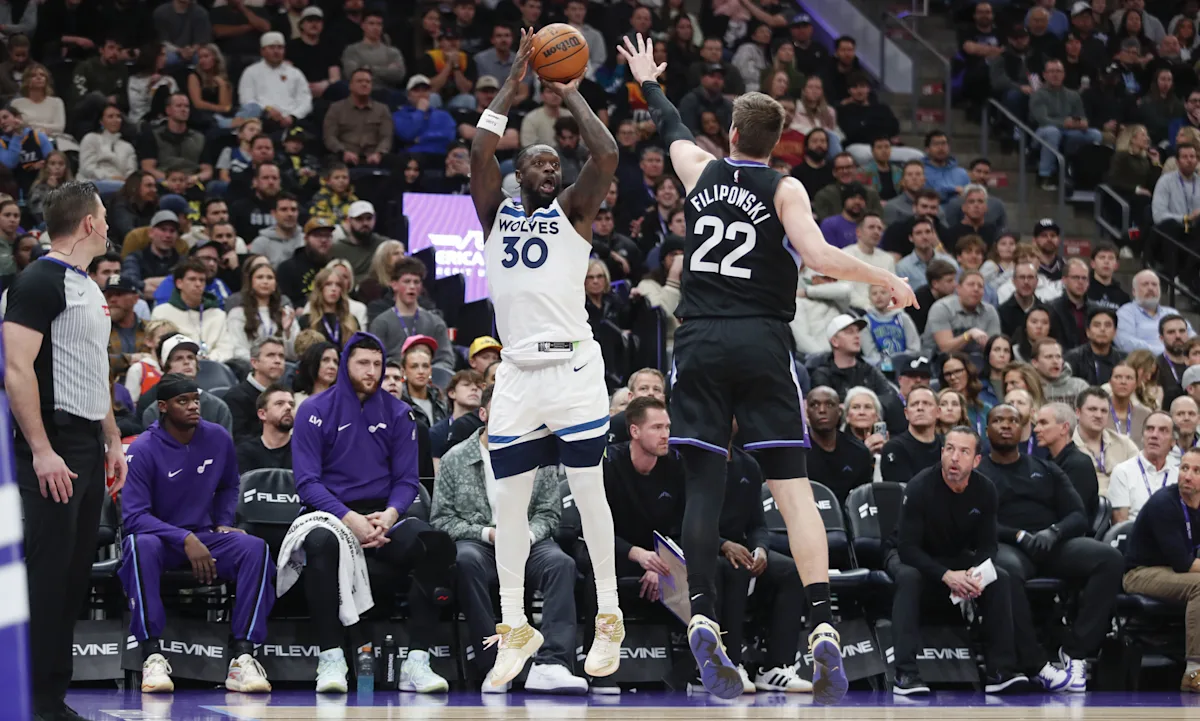
Minnesota Timberwolves vs. Utah Jazz
Date: March 18th, 2026
Time: 7:00 PM CDT
Location: Target Center
Television Coverage: FanDuel Sports Network – North
Radio Coverage: KFAN FM, Wolves App, iHeart Radio
For one night at least, the Minnesota Timberwolves managed to pull themselves back from the edge.
Advertisement
With word breaking Monday night that Anthony Edwards would miss the game against Phoenix and then the even more concerning follow-up that the absence could stretch one to two weeks, Tuesday night had all the makings of a game that could send a season spiraling. The Wolves entered it already walking the tightrope in the Western Conference standings, with the Suns lurking directly beneath them and the play-in line looming dangerously close. Lose that game, and suddenly Phoenix is right back in the mix, Minnesota’s margin for error is basically gone, and all of the bad vibes from the past week get amplified. Win it, and the team could buy itself some breathing room and a little bit of hope they can tread water until Ant returns.
Thankfully for the Wolves, they answered the bell.
Things did not start in particularly inspiring fashion. Minnesota came out in the first quarter and defended like a team that had not fully grasped the gravity of the moment. Phoenix was getting to the rim at will. The Wolves were coughing up turnovers. The effort level and the execution both looked shaky, and before long the Suns had pushed out to an 11-point lead. It had all the signs of one of those ugly nights where the Wolves spend the first half sleepwalking, then have to talk themselves into urgency after the damage is already done. By the end of the first quarter, Minnesota had at least stabilized enough offensively to climb back within 39-36, but let’s be honest, giving up 39 points was not exactly the kind of opening act that builds confidence.
But to the Wolves’ credit, they actually responded like a serious team. Over the final three quarters, Minnesota allowed just 65 points. That is an enormous course correction and, frankly, exactly the kind of defensive resilience this team needed to show if it wants to be taken seriously without Edwards in the lineup. The game flipped because the Wolves finally started acting like the bigger, more athletic, more defensively imposing team. The rim protection came alive. The rotations tightened. Phoenix stopped getting those easy runway looks that had fueled the first-quarter surge. Once the Wolves got the game onto their terms, the Suns simply did not have enough resistance to hold up over 48 minutes.
Advertisement
One of the biggest reasons Minnesota survived and then took control was Julius Randle, who once again stepped into the role of offensive centerpiece and delivered exactly what the Wolves needed. Randle finished with 32 points, building on the positive signs he had shown against Oklahoma City and looking much more like the early-season version of himself than the post-All-Star guy who had been drifting in and out of games. He attacked the paint, scored with force, and, most importantly, he looked like he understood that without Ant on the floor, this team was going to need him to be more than just a complementary scorer. It needed him to be the guy.
Next up was Bones Highland, who gave Minnesota exactly the kind of spark bench scorers are supposed to give but so rarely do on command. Bones poured in 22 points, injecting life into the second unit and helping keep the offense afloat during stretches where it might otherwise have bogged down. In a game where Minnesota desperately needed somebody other than Randle to create and convert, Bones stepped in as a microwave scorer.
The frontcourt also rediscovered its identity. Rudy Gobert, coming off a rough outing against the Thunder, reasserted himself around the basket and made the paint feel like a restricted government zone. Gobert finished with four blocks, and he wasn’t alone. Naz Reid also had four blocks, giving Minnesota a combined eight swats between its two most important interior defenders. More than the block totals themselves, it was the tone that mattered. The Wolves used their size, length, and rim protection to turn the game from a first-quarter track meet into a grind, and Phoenix never really recovered once that happened.
There’s not much time to savor it, though, because Utah is rolling into Target Center for the second night of a back-to-back. Under normal circumstances, a home game against a depleted Jazz team might feel like one you circle as a probable win and move on. But this Wolves team has spent the season proving that no game is actually easy if they decide to treat it like a formality. And with Edwards still sidelined, nothing gets to be taken for granted.
Advertisement
Utah, by all appearances, is actively angling for lottery position. They will be without Lauri Markkanen and Jusuf Nurkic. Keyonte George, who went on that scoring binge to steal the last game from Minnesota in Utah, is out as well. Ace Bailey is listed as questionable. On paper, it looks like a setup. On paper, the Wolves hold a clear talent edge even without their superstar. On paper, this should be a “take care of business and move on” type of night.
But Wolves fans have seen enough “on paper” games turn into disasters to know better.
So with that, here are the keys to the game.
#1 – The Wolves cannot play with their food.
This has to be the theme of the night. They cannot look at Utah’s injury report and mentally chalk up the win before the opening tip. That is how bad teams get confidence. That is how random role players start feeling dangerous. That is how you wake up midway through the fourth quarter in a one-possession game wondering how the hell this happened. Even a tanking team still has NBA players, and those players would absolutely love to walk into Target Center, get extra run, and prove they belong. The Wolves need to choke this thing out early. Strong team defense, good pace, and focused execution need to be present from the jump so this game does not become a fourth-quarter survival test on tired legs.
Advertisement
#2 – Dominate around the rim.
Phoenix came in shorthanded in the frontcourt and the Wolves eventually made them pay for it. Utah is bringing a similar setup. This should be a game where Gobert once again functions as a force field around the basket. He needs to rebound, block shots, and make every Jazz drive feel like a bad idea. Randle and Naz also have to carry over the physicality from the Suns game. If Minnesota’s big three in the frontcourt treats this like a paint war, Utah simply should not have enough size or interior talent to hold up over four quarters. This is one of those games where the Wolves need to look bigger, stronger, and more punishing than the other team, simply because they are.
#3 – The ball movement has to continue.
One of the more interesting byproducts of Edwards being out was how willing the Wolves were to move the ball and play team offense. That’s not meant as some shot at Ant, because everyone understands why he dominates the ball at times. He’s the star. He’s the bailout option. He’s the guy who can rescue possessions when everything else fails. But with him off the floor, the Wolves had no choice but to trust the pass, trust each other, and keep the offense from stagnating. That led to better involvement from Bones and Ayo Dosunmu, and it gave the offense a little more collective rhythm. That has to continue. Against Utah, the Wolves can absolutely survive without Edwards’ individual offense if they maximize possessions, create good looks, and stay unselfish.
Advertisement
#4 – Clean up the turnovers.
The Wolves were better against Phoenix than they had been against Oklahoma City, but only because it was nearly mathematically impossible to be worse. Sixteen turnovers is still too many. Without their best player, the Wolves cannot afford to hand away possessions and give the other team transition points. Against a Jazz team that shouldn’t be able to generate much easy offense on its own, the absolute worst thing Minnesota can do is gift-wrap opportunities. This is where professional basketball comes in. Take care of the ball. Finish defensive possessions. Hit your free throws. Don’t make life harder than it needs to be. If the Wolves handle the basic stuff, their talent advantage should take over.
#5 – Julius Randle has to keep being Big Julius.
This is probably the biggest swing factor during Edwards’ absence. Earlier in the season, when Ant missed time with his foot issues, Randle carried the scoring burden and looked like a true offensive hub. Then he hit that post-All-Star funk and became a shell of that guy. The signs against OKC were encouraging, and the performance against Phoenix was more than encouraging and exactly what Minnesota needed. Now comes the challenge of doing it again. Randle has to keep scoring efficiently, keep making the right play when help comes, and keep balancing his own offense with the playmaking element that makes him so dangerous. When he draws defenders and kicks to open teammates instead of stopping the offense, Minnesota becomes much harder to guard. Without Edwards, that version of Randle is not just useful, it’s essential.
This is the kind of game that is easy to dismiss because it probably won’t be pretty and it certainly won’t feel gratifying. But these are the kinds of games that determine whether you stay well above the play-in line or spend the last two weeks of the season sweating every scoreboard update. Tuesday against Phoenix was a must-win, and the Wolves treated it like one after the first quarter. Wednesday against Utah needs to be approached the same way. Then comes Portland on Friday. These are the games Minnesota has to bank, especially while Edwards is sidelined, especially before the schedule stiffens again, and especially because they’ve already made this season harder on themselves than it needed to be.
Advertisement
Nobody is asking for art here. The expectation isn’t some beautiful, flowing masterpiece of offensive basketball. This team just has to be mature, focused, and professional. It needs to be one of those nights where the better team comes out, takes care of business, and moves on.
Given this team’s history, that still feels like a bigger ask than it should.
But if the Wolves are serious about holding their ground in the West while Ant is out, it’s exactly what they have to do.