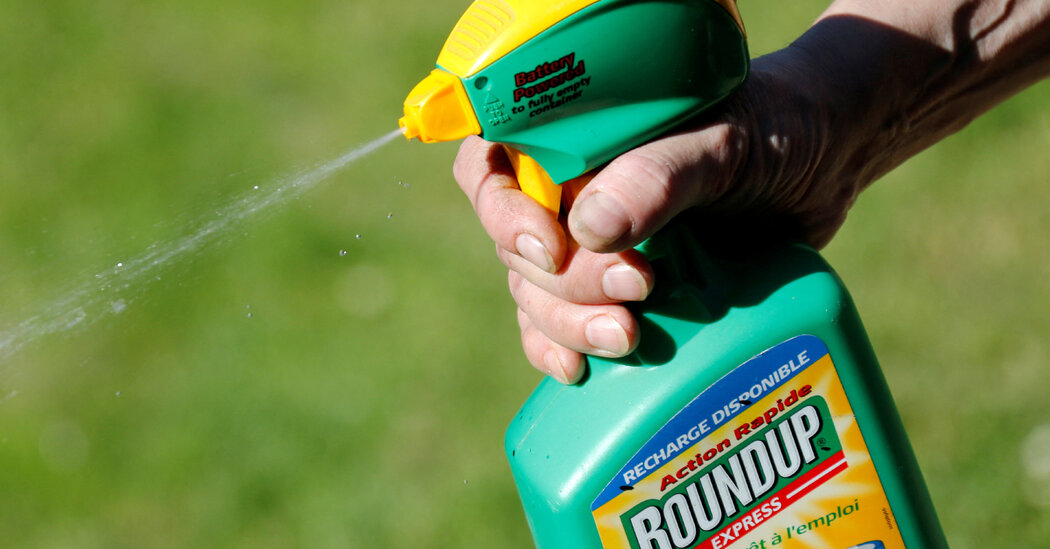
President Trump issued an executive order late Wednesday aimed at spurring the domestic production of glyphosate, a widely used weedkiller that has figured in health lawsuits.
The move immediately set off alarms among supporters of Health Secretary Robert F. Kennedy Jr.’s “Make America Healthy Again” movement, and appeared to put Mr. Kennedy in an awkward position.
Glyphosate is the active ingredient in Roundup, which has been the target of tens of thousands of lawsuits that claim it causes non-Hodgkin’s lymphoma. In 2018, as a plaintiff’s lawyer, Mr. Kennedy helped win a landmark $289 million jury verdict against Monsanto, the maker of Roundup, in a case contending the company knew the weedkiller caused cancer.
But in a statement issued through a spokesman Wednesday night, the health secretary said he supported the president.
“Donald Trump’s executive order puts America first where it matters most — our defense readiness and our food supply,” Mr. Kennedy said in the statement. “We must safeguard America’s national security first, because all of our priorities depend on it.”
Mr. Trump’s order invoked the Defense Production Act, a 1950s-era law typically used in national emergencies to compel companies to produce certain materials or supplies that the president deems necessary for national security. Mr. Trump declared both glyphosate and phosphorus, used to manufacture the weedkiller, “critical to the national defense.”
“Lack of access to glyphosate-based herbicides would critically jeopardize agricultural productivity, adding pressure to the domestic food system,” Mr. Trump argued.
He ordered the agriculture secretary, in consultation with the defense secretary, to “determine the proper nationwide priorities” and gave them authority to compel production of the materials “to ensure a continued and adequate supply” of phosphorous and glyphosate-based herbicides, if necessary.
Some of Mr. Kennedy’s supporters, as well as environmental groups, were furious.
“MAHA voters were promised health reform, not chemical entrenchment,” said Vani Hari, a healthy eating advocate and supporter of Mr. Kennedy’s nutrition agenda. She called the executive order “a direct assault on MAHA” and “a gift to pesticide and chemical industry lobbies at the expense of human health.”
Ken Cook, the president and co-founder of Environmental Working Group, an advocacy organization that has also supported parts of Mr. Kennedy’s agenda, said, “I can’t envision a bigger middle finger to every MAHA mom than this.”
Mr. Kennedy has taken an aggressive posture on pesticides in the past. “The chemicals pollute our bodies the same way that they pollute the soil,” he said in 2024. In a report issued last year, a commission he chaired to examine the causes of chronic disease singled out glyphosate and another pesticide, atrazine, as potentially harmful to children.
While many experts say the risks of glyphosate to the general population are low, bodies reviewing research have had differing conclusions. In 2015, the International Agency for Research on Cancer classified glyphosate as “probably carcinogenic to humans.” Two years later, the Environmental Protection Agency said that glyphosate was “not likely to be carcinogenic to humans.”
Late last year, a landmark study that had found glyphosate to be safe 25 years ago was retracted by the scientific journal that published it, undermining confidence in the science behind a weedkiller that has become integral to American food production. It is used on soybeans, corn and wheat, on specialty crops like almonds, and on cotton and in home gardens.
The Defense Production Act provides a pathway for companies to be shielded from certain liability suits, and Mr. Trump’s order appeared to extend that protection to producers of glyphosate. The Supreme Court is set to hear arguments in weeks in a case that asks whether federal law shields pesticide manufacturers from such lawsuits.
Last year, a coalition of environmental groups, MAHA activists and Democratic lawmakers defeated a provision tucked into a government spending bill that would have shielded Bayer and other pesticides makers from payouts to plaintiffs. A similar provision has now been introduced in the draft Farm Bill.
Brett Hartl, director of government affairs for the Center for Biological Diversity, which has filed multiple lawsuits challenging the E.P.A.’s approval of the herbicide, said the provision raised red flags. “It’s alarming because it’s clearly designed to offer a broad immunity,” he said.
Bayer, the German pharmaceutical and biotech giant that acquired Monsanto in 2018, announced on Tuesday that it had reached a tentative agreement that would pay plaintiffs $7.25 billion to settle tens of thousands of lawsuits that claimed Roundup caused cancer. The company maintains that the weedkiller is safe and an essential tool for farmers.
The company will continue to press its case at the Supreme Court, Bill Anderson, Bayer’s chief executive, told investors on Tuesday. He said a favorable ruling would provide “the tightest possible form of containment” of litigation by settling existing cases and making future cases easier to win.
In a statement on behalf of Monsanto, a Bayer spokesman said that Mr. Trump’s executive order “reinforces the critical need for U.S. farmers to have access to essential, domestically produced crop protection tools.” The company will “comply with this order to produce glyphosate and elemental phosphorus,” he said.
Knvul Sheikh contributed reporting.